
Accra, Ghana
West Africa's most stable and welcoming capital — Accra combines a proud democratic heritage, a rapidly growing economy, and an infectious warmth of character that makes it one of the most genuinely enjoyable and professionally relevant training destinations on the African continent.

WHY ACCRA
West Africa's gateway city
Accra is the capital of one of West Africa's most stable, well-governed, and internationally respected democracies — a city that has built a reputation for institutional transparency, peaceful political transitions, and a welcoming openness to international professionals and investment that is the envy of the wider region. As Ghana's economy continues to diversify — with growing sectors in oil and gas, financial services, technology, and agribusiness — Accra has established itself as one of the most important professional development hubs in West Africa.
West Africa's most stable economy
Consistently ranked among West Africa's most transparent and well-governed economies — a growing financial services sector, a thriving technology ecosystem, and significant oil and gas revenues anchor Accra's commercial significance.
Well connected
Kotoka International Airport (ACC) offers direct flights from London, Dubai, Riyadh, Nairobi, Lagos, Addis Ababa, and major African and GCC cities via British Airways, Emirates, and regional carriers.
The Gateway to West Africa
Ghana's political stability, English language environment, and welcoming culture make Accra the natural choice for professionals from across West and Central Africa seeking a training destination combining regional relevance with genuine accessibility.
Excellent value
World-class training facilities and comfortable hotels at a significantly lower cost than European destinations — highly accessible for organisations and governments managing training budgets across West and Central Africa.

Beyond the classroom
CULTURE & ATTRACTIONS
Accra rewards exploration with a rich blend of Ghanaian cultural heritage, Atlantic coastal scenery, and a vibrant contemporary urban energy — a city where the legacy of the trans-Atlantic slave trade, the pride of African independence, and the momentum of modern development exist in powerful and meaningful proximity.
Attraction
What to expect
Independence Square & Black Star Gate
The centrepiece of Ghana's national pride — Independence Square, where Kwame Nkrumah declared Ghana's independence in 1957, and the iconic Black Star Gate are among the most symbolically significant sites in the history of African liberation.
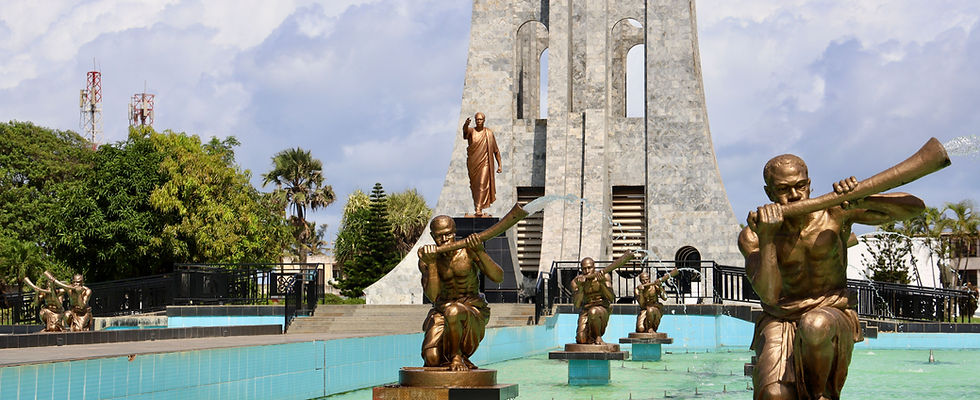
Kwame Nkrumah Memorial Park & Mausoleum
The final resting place of Ghana's founding father and pan-African visionary — a beautifully maintained memorial park and museum celebrating one of the most important political figures in African history.
Cape Coast Castle (excursion)
Approximately 2.5 hours from Accra — a UNESCO World Heritage Site and one of the most significant historical sites in Africa. The Cape Coast slave castle, where millions of enslaved Africans passed through the Door of No Return, is a profoundly important heritage experience.
National Museum of Ghana
Ghana's principal museum — housing outstanding collections of Ghanaian cultural artefacts, traditional textiles, royal regalia, and natural history. An essential introduction to the depth and diversity of Ghanaian cultural heritage.
Makola Market
Accra's largest and most vibrant market — a vast, colourful, and energetic commercial hub at the heart of the city. An authentic and immersive insight into the commercial culture and daily life of contemporary Accra.
Accra's most popular beach — a lively stretch of Atlantic coastline with a relaxed social atmosphere that captures the warmth and vitality of Ghanaian outdoor culture. A pleasant after-training escape within easy reach of the city centre.
Labadi Beach
Osu & the Oxford Street area
Accra's most cosmopolitan neighbourhood — a lively grid of independent shops, international restaurants, art galleries, and vibrant street culture. The social heart of the city's growing middle class and a very pleasant area to explore in the evenings.
Accra Arts Centre
Ghana's principal arts and crafts market — a large open-air complex specialising in Kente cloth, Adinkra textiles, woodcarvings, jewellery, and traditional instruments. One of the finest craft markets in West Africa.
WEATHER
What to expect throughout the year
Accra has a tropical savannah climate — warm and humid year-round, with two rainy seasons and two drier periods. The harmattan season from December to February brings drier, dustier air from the Sahara. The city is a fully operational training destination throughout the year.
Season
Temperature
Notes
Dry season (Nov–Mar)
24°C – 33°C
Drier and slightly cooler. The most comfortable season for training. Harmattan winds from December to February bring drier air — a light layer may be useful in the evenings.
Rainy season (Apr–Oct)
22°C – 30°C
Warm with regular showers — two rainfall peaks in April-June and September-October. Lush and green. A compact umbrella is essential. Training continues normally indoors.
Dress Code Guidance
Context
Training sessions
Smart business or casual attire. Abuja's professional culture — particularly in government and regulatory settings — is formal. Delegates are encouraged to dress smartly and conservatively. Venues are well air-conditioned; a light layer is advisable for indoor sessions.
City Exploration
Light, breathable clothing strongly recommended given the tropical heat and humidity. A compact umbrella or light rain jacket advisable during the rainy seasons. Comfortable walking shoes recommended. Sun protection advisable year-round.

GETTING AROUND
Navigating the city
Accra is best navigated by taxi or ride-hailing service. Traffic congestion, particularly during peak hours, can be very significant — delegates are strongly advised to allow additional travel time. Most venues, hotels, and attractions are spread across a manageable cluster of central and near-central districts.
Mode
Deatils
Taxis & ride-hailing
Uber, Bolt, and Yango all operate in Accra and are the most practical and recommended options for delegates. Metered taxis are also available at major hotels and the airport. Ride-hailing is strongly recommended over hailing taxis on the street for unfamiliar visitors.
Airport connections
Kotoka International Airport (ACC) is approximately 8 kilometres from the city centre — approximately 15-30 minutes by taxi or Uber depending on traffic. The airport is compact and efficiently managed. Most major training hotels offer private transfer services.
Bus network
The Metro Mass Transit and Aayalolo BRT systems serve key routes across the city. A practical and affordable option for delegates along the main corridors. For most international visitors, ride-hailing offers greater convenience and reliability.
Car hire
Available at the airport and from established operators in the city. Recommended for delegates visiting Cape Coast Castle, the Volta Region, or destinations outside the city. An international driving permit is recommended. Driving is on the right-hand side of the road.
Walking
The Osu, Cantonments, and Airport City areas are pleasant to walk within during daylight hours. Delegates are advised to use ride-hailing after dark. The tropical heat and humidity make extended walking uncomfortable outside of the early morning and evening hours.

PRACTICAL INFORMATION
Before you arrive
Key practical details to help delegates from across the GCC, Africa, and Asia prepare for a comfortable and productive visit to Accra.
Topic
Information
Currency
Ghanaian Cedi (GHS). Card payments accepted at major hotels, supermarkets, and established restaurants. Carrying cash is advisable for markets, smaller establishments, and local transport. ATMs available at the airport, major banks, and throughout the city centre. US Dollars accepted at some hotels and larger establishments.
Time Zone
GMT (UTC+0) year-round — Ghana does not observe daylight saving time. Accra is 3 hours behind Riyadh, 4 hours behind Dubai, 3 hours behind Nairobi and on the same time as London in winter.
Electricity
Type D and G plugs are both in use in Ghana, 230V / 50Hz. Type G (three rectangular pins — same as the UK) is the most common in hotels and modern buildings. UK delegates will find their plugs compatible in most venues. GCC and Asian delegates will require a UK-style or universal adaptor.
Places of Worship
Accra has numerous mosques throughout the city. Christian delegates are exceptionally well served — Ghana is a predominantly Christian country and Accra has hundreds of churches of every denomination, from historic Anglican and Catholic cathedrals to vibrant evangelical congregations. A Qibla direction indicator is available on request at most international hotels. Muslim delegates are advised that the Muslim Pro app provides accurate prayer times and Qibla direction worldwide.
Halal Dining
Accra has a significant Muslim community and a growing halal food scene. Halal-certified restaurants are available across the city, with a strong concentration of West African, Lebanese, and international halal options in the Osu, Cantonments, and Airport City areas near major training venues.
Language
English is the official language of Ghana and is spoken throughout Accra in business, government, education, and daily life. Twi is the most widely spoken local language. Delegates will encounter no language barrier in professional and hotel environments. All training courses are delivered in English.

Ready to train in Accra?
Browse our full programme of courses and reserve your place today.
